
By Courtni Fields, Audrey Henvey, Keyuri Parab and Ariana Vera
As a child, Pantego resident Sophie Soueid would dehydrate herself because she didn’t want to drink the tap water.
She described the taste of the water as soapy and “mineral-y”.
“It’s definitely not pleasant,” she said.
When she got older, she started buying water bottles so that she could stay hydrated. Soueid now spends $30 per month on bottled water.
For her, it’s not about the fear of contamination. She just doesn’t like the taste or smell of the water her town provides.
Soueid is not the only resident to express distaste concerning Pantego’s water. Many complaints have come from newer residents and businesses who say they can’t drink or cook with the water because of its taste and smell.
The Pantego system is rated by the Texas Commission on Environmental Quality as a superior water system. The water undergoes regular—even daily—tests by the city and state. But the option of changing Pantego’s water source to that of another city, like Arlington, has been on the town council agenda multiple times without resolution. The council is split on which way to go, and it remains common knowledge that there is something different about the water in Pantego.
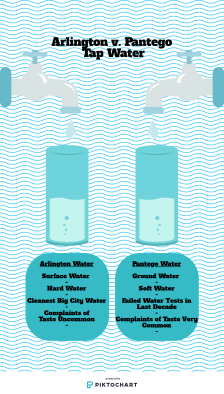
Pantego City Manager Matthew Fielder said it’s a matter of surface water in comparison to groundwater. The town of Pantego sources it water from wells while surround cities like Arlington and Dalworthing Gardens use surface water.
The water coming from Pantego’s five wells is full of minerals and a higher salinity content that results in a different taste, Fielder said. Because surface water tends to hold more contaminants, it requires more treatment. Groundwater, he said, does not have those contaminants and therefore only requires a chlorine injection for purification.
Communities must provide a consumer confidence report on water quality every year by July 1 of the year, according to the National Primary Drinking Water Regulations written by the Environmental Protection Agency
In the past five years, the town of Pantego has had three water violations, according to the town’s water quality reports. The violations occurred in 2014 and 2017.
Pantego had two violations in 2014. The city failed to test its water from Oct. 1 to the end of the year, according to the 2014 report. Because of this failure, the city could not confirm the quality of its drinking water at the time. That same year, reports indicated the total amount of coliform bacteria in the drinking water during December violated the standard.
There were not any water quality violations in 2015 or 2016. But in 2017, the amount of coliform bacteria exceeded the standards, according to that year’s water quality report. Repeat samples were taken which were negative for the bacteria.
During the investigation, it was found that the 2017 water report was unaccessible on the town website but was later provided through email. The report was found to be back on the website on May 2, 2019.

Resident concerns
Pantego resident Zachary Holloway said he moved to the city at the beginning of the year and was informed about the taste by his roommate, Sophie Soueid.
Holloway said the taste of the water is so bad that even the Brita filter won’t get rid of it and that he and Sophie Soueid only use bottled water.
“It doesn’t really smell as such, at least currently,” Holloway said. “It kind of tastes like the slightest hint of like rot or ash that kind of thing.”
Fielder said Pantego water, which is groundwater, is pumped from wells, unlike Arlington’s surface water.
Groundwater is treated differently than surface water. It also has a different mineral content and undergoes a different water treatment, which results in its distinct taste and smell, he said.
“We get questions about the taste and smell all the time,” Fielder said. “It’s different, but to answer the question whether it’s safe or not, we meet all the drinking water standards for the Texas Commission on Environmental Quality.”
Sophie Soueid said she knows it’s safe to drink, but she won’t be switching from bottled water to tap.
She said she likes Arlington water better for drinking, but prefers to shower in Pantego water which is soft water and is gentle on her hair and skin.
Her mother, Alicia Soueid, has lived in Pantego for 26 years. She said the water’s smell and taste doesn’t bother her. She drinks tap water through a filter in her refrigerator.
“I think I just personally just decided a long time ago I was just going to deal with it,” she said. “Not spend the money or bother with the bottled stuff, you know.”
Fielder said newer Pantego residents tend to be worried about the water smell and taste because they are not used to the taste of groundwater. However, longtime residents are happy with it, he said.
Kim Fields, a former Pantego resident of 13 years, has a history of issues with the water. In all of the years they lived in Pantego they never drank the water. It even caused issues with their pool and required extra chemical treatments.
“It turned the metal on our faucets. it basically ate away the metal, the sinks, the handle and everything,” Fields said.
Fields’ family spent $60 a month buying bottled water for drinking and cooking. They never used their ice machine because of all the complications. They never even turned it on, Fields said, and instead would buy ice from the store and keep it in their freezer.
“I was so excited to move to Dalworthington because I was gonna be able to get ice out of my ice machine for the first time in 13 years,” she said.
Fielder said he has never heard complaints about water eating through systems.
Commercial concerns
The water has not only affected residents but also business owners in the area.
The McDonald’s on Bowen Road and Pioneer Parkway gets Pantego water through its pipes. It has caused multiple problems with equipment and product quality.
Every McDonald’s has a standardized reverse osmosis filtration system, but the water has chewed through several of the systems as well as other pieces of machinery, said Keith Vanecek, owner and operator of the Pantego McDonald’s.
“This water has eaten through heating elements in our coffee machines where we have spent thousands and thousands of dollars replacing elements and pieces of equipment,” Vanecek said.
Even with additional filtration systems added to the standard machines, the McDonald’s still struggles with the water.
“It’s tough,” said Tim Burk, Vanecek’s Vice President of Operations. “That well water is just almost impossible to use. You can’t make ice out of it, hard ice, that is, and from a flavor perspective it’s all over the board.”
Making good ice is important to a Mcdonald’s for making its frappuccino iced coffees. But at the Pantego store, the drinks would not freeze.
The problem was noticed when the frozen coffee machine was installed and a McDonald’s executive from Illinois came to help them, Burk said.
The executive told Burk and Vanecek they were losing money on their beverages.
“He picked up an ice cube and put it between his finger and his thumb and smashed it,” Burk said. “It splattered and he said ‘your ice is not frozen.’”
He said the water also causes erosion of the workstation tiles and kills the flowers in their landscaping.
The town has received complaints about dying plants. Fielder said the higher salinity content in the well water makes certain plants unable to survive. This does not affect all plants, he said.
As for the difficulty with water systems, Fielder said he has never heard any comments of that nature.
One of the well sites in the town has required more constant replacement due to corrosion, however. Located on West Pioneer Parkway, the well’s system components were replaced two months ago due to corrosion issues with the well pump, Fielder said.
He said the town had an engineering company come out to find a cause for the more rapid need for replacement. The company tested the water, electrical currents and ground currents for a possible cause.
“On this one, those were all indeterminant,” Fielder said.
Shisha Cafe, a popular hookah lounge in the city, does not serve tap water, said co-owner Mo Shahin. When the cafe originally opened, it did serve the water. But it was the water’s strange taste that caused them to make the switch to just bottled water, he said.
When the cafe still used the tap water, especially in its teas and coffee drinks, staff would hear complaints from customers.
“From what customers tell me, it’s a sewer taste,” Shahin said.
The cafe now cooks with filtered water.
Some may think that the cafe would make some extra money by only offering water bottles, but Shanin said this is far from the case.
He said the cafe has to purchase bulks of water bottles every two weeks, costing them between $500-600 a month, not including the cost of the filters. They cook all their food with filtered water.
Not serving tap water does make the cafe subject to complaints, he said. But he said he’d rather hear complaints about not serving tap water than serving something that tastes ‘like a sewer.’
The water meets safety requirements and is tested constantly in labs as required by the EPA, Fielder said.
“We do hear from restaurants that people will prefer will not want to drink tap water because it’s tasting different,” he said. “But it’s not a safety issue. It’s merely a taste issue.”
To Kim Feil, local environmental blogger and activist, Pantego water isn’t just a Pantego issue. She said it’s an Arlington issue too.
Most Arlington residents live minutes away and eat and drink in Pantego often. Feil sent her son to Pantego Christian Academy for middle school. That’s when she began following the city’s water reports and became concerned with the cyanide levels, she said. She packed him with a large water bottle everyday with his lunch, she said.
“I would have thought by now that they would have gone to Arlington’s water,” Feil said.
Surrounding cities like Kennedale have changed their water source to Arlington’s, she said.
Weighing the options
The prospect of switching to Arlington’s water system has been on the town council agenda multiple times, said Pantego Mayor Doug Davis. However, the decision has never been made.
Fielder said that those who support maintaining a use of Pantego’s groundwater source cite the cost of using another city’s system and a desire for local control.
If the town were to receive treated water from Arlington, the city would control the pricing and would charge Pantego a higher price than it does Arlington residents, Fielder said. Pantego would have no control over Arlington’s yearly pricing choices, he said.
However, Fielder said the city doesn’t have hard data on how the costs would compare if the town moved away from well water.
“And that’s been a big part of the debate is that we don’t have the true information on if we get rid of the wells, what would our water rates look like at that point,” Fielder said.
Craig Stowell with the TECQ said the costs of switching to an alternate water source could prove expensive for the city, and the priority of changing would most likely be low if it is a matter of taste and smell.
The piping of an interconnect between the two municipalities would cost about $10,000, cheaper than the prospective $100,000 it would cost to drill a new well. But the cost of water per thousand gallons would most likely increase from about $2 to $3 or $4.50, Stowell said.
“So it’s not always an easy decision no matter which way you go,” he said.
In an Oct. 20, 2017 post, the Town of Pantego Facebook page suggested residents use personal carbon filters that could be purchased from a hardware store. Fielder said he’s heard residents and restaurants say using personal filters does help alleviate the taste.
The town considered adding more filtration on the supply end of the water system, Fielder said, but determined the costs were too great.
“I’ve been told it would be cheaper to buy every homeowner their own filter than to do a central filtration system,” Fielder said.
For now, Sophie Souied will continue buying bottled water. She feels “hidden costs” might present themselves if the town switched to Arlington water.
“I wouldn’t say its a quality of life thing, because to me quality of life is access to clean water which we do have,” she said. “I think I am okay with what I have right now, but I would prefer to drink Arlington water.”
 Keyuri Parab